China’s K Visa Alternative to the U.S. H-1B Visa

By Faith Ugwuoti
Starting 1 October, China will launch the K visa. It is aimed at young STEM professionals and eliminates the requirement for a local job offer before applying. The K visa offers more extended stays, multiple entries, and lower costs compared to the H-1 B visa of the United States.
As global competition for high-skilled professionals intensifies, China is positioning itself as an attractive destination for STEM talent with the expansion of its K Visa program.
The H-1B

Once a Gateway, Now a Bottleneck. In contrast, the U.S. H-1B program, which has historically served as the main pipeline for skilled foreign workers, has become increasingly challenging to navigate. Over the past several years, administrative changes have raised the bar for applicants and sponsoring companies alike. Increased scrutiny, higher filing fees, wage-level requirements, and restrictive definitions of “specialty occupations” have all contributed to a shrinking pool of successful applicants.
While President Trump’s administration recently imposed a $100,000 fee for most new H-1B visa petitions, effective 12:01 AM on 21 September 2025, causing prolonged uncertainty for foreign talent considering the U.S. as a destination.
The China K Visa stands in stark contrast to the United States’ beleaguered H-1B visa system, which has faced growing criticism for being costly, restrictive, and increasingly inaccessible. Holders, on the other hand, can study, conduct research, and engage in business activities.
Key Features of China’s K Visa:
- Broad Activities Allowed: Holders can engage in exchanges and collaborations in education, culture, science, and technology, as well as participate in entrepreneurial and business activities.
- Increased Flexibility: The K visa will offer greater freedom in terms of the allowed frequency of entries, the total duration of validity, and the permitted length of stay in China.
- Targeted for STEM Talent: The Visa is specifically for young individuals in Science, technology, engineering, and mathematics.
- No Sponsor Required: Unlike many other Chinese visas, K visa applicants will not need an invitation letter from a domestic employer or entity to apply.
Beijing is introducing a K visa to its existing visa categories, which will be available to eligible young professionals in science and technology. China’s Premier Li Qaing has signed a decree to proclaim the decision to amend the regulation on the administration of foreigners’ entries and exits.
Key Differences: China’s K Visa vs. the U.S. H-1B Visa
| Feature | China’s K Visa (effective 1 October 2025) | U.S. H-1B Visa |
| Primary purpose | To attract and retain young talent, especially in STEM fields, and foster China’s innovation ecosystem. | To allow U.S. employers to hire foreign workers in “specialty occupations” where labor shortages exist. |
| Sponsorship | Not required. An individual can apply directly for the visa, making it a more flexible option. | Required. A U.S. employer must file a petition with U.S. Citizenship and Immigration Services (USCIS) on behalf of the prospective employee. |
| Target audience | Young professionals, researchers, and entrepreneurs with a bachelor’s degree or higher in a STEM field from a recognized university. | Skilled workers in a wide range of specialty occupations that require at least a bachelor’s degree or its equivalent. |
| Activities allowed | A broad range of activities, including academic exchanges, research, entrepreneurship, and general business. | Tied directly to the specific job and employer for which the petition was approved. |
| Annual cap | There is no stated annual cap, which suggests potentially broader access for all eligible applicants. | Subject to an annual cap, which is currently 85,000 visas per year. When demand is high, a lottery system is used to select applicants. |
| Application process | Intended to be more streamlined and less bureaucratic, with the application based on the individual’s qualifications. | A complex, time-consuming, and expensive process that requires multiple steps for the employer and employee. |
| Cost | The exact fee schedule is pending, but it is expected to be less expensive due to the lack of employer sponsorship. | Can be substantial for employers, involving various filing, anti-fraud, and training fees. |
| Path to residency | Details on a long-term residency path have not yet been fully clarified. | Has a “dual intent” provision that allows a visa holder to seek permanent residency in the U.S.. |
Strategic context
China’s introduction of the K visa is widely seen as a strategic response to recent changes in U.S. H-1B policy. As the U.S. increases costs and regulatory hurdles for the H-1B, China is attempting to position itself as a more welcoming and flexible destination for global STEM talent. The K visa allows China to compete directly with the U.S. for skilled young professionals in science and technology.
China’s new K visa offers more flexibility than its 12 ordinary visas, allowing multiple entries, longer validity, and extended periods of stay.
Holders of the K Visa will benefit from:
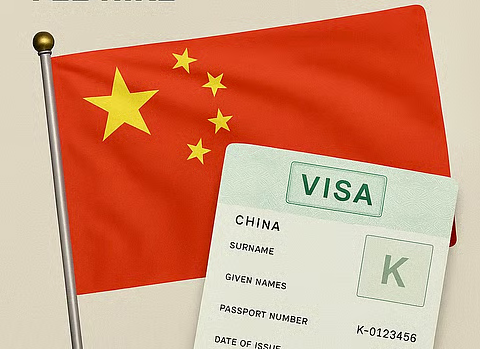
- Flexible stay durations for more extended periods
- Multiple re-entries without needing to reapply
- No requirement to be employed by a Chinese entity
- Eligibility for accompanying family members
This flexibility is particularly appealing to academics, researchers, and early-stage entrepreneurs who may not have traditional employment lined up but bring valuable expertise and innovation potential.
A Changing Global Landscape
With Canada, Germany, and Singapore also ramping up immigration pathways for highly skilled workers, the global race for STEM talent is no longer just about economic opportunity; it’s also about regulatory clarity, personal freedom, and quality of life.
If the U.S. hopes to maintain its position as a magnet for global talent, experts suggest reforms are urgently needed. In the meantime, programs like China’s K Visa are quietly reshaping the map of international mobility for scientists and innovators.
The China K visa plays a vital role in facilitating family reunification and long-term residence for foreign nationals. It will pave the way for future travelers seeking greener pastures to evolve in the global system seamlessly, whether through intrapersonal skills, entrepreneurship, or educational qualifications. Staying informed and prepared is essential for a smooth and successful application experience.
The registration for the China Canton Business visa for the last quarter of the year is now open, and we can provide professional assistance.
)
)
)